
A Complete Guide to
What Are School Developer Fees?
A complete guide to California school developer fees for developers, builders, property owners, and school districts — what they are, who pays, how they are calculated, and when they are due.

Introduction
School Developer Fees Explained
School developer fees help fund the school facilities that new development brings demand for — and getting them right matters on both sides of the counter.
School developer fees are charges that qualifying California school districts may impose on certain construction and development projects to help fund the construction or reconstruction of school facilities associated with development. Also called school development fees or school impact fees, these charges can apply to new residential, commercial, industrial, and other qualifying construction within a school district's boundaries.
For developers, builders, property owners, and project applicants, understanding school developer fees is an important part of estimating costs and completing permitting and compliance requirements. For school districts, administering developer fees requires accurate project information, current fee schedules, payment records, and consistent documentation.
Verify before you rely on any figure
Developer fee rates, exemptions, calculation methods, and payment requirements can depend on California law and the applicable school district's requirements. Always verify current rates and project requirements with the applicable school district.
This guide covers the complete process, from determining whether a project may be subject to school developer fees to calculating, paying, documenting, and managing those fees.
This guide explains
- What school developer fees are and why districts charge them
- Who pays, and which projects may be subject to fees
- How developer fees are calculated, and how much they can be
- When fees are due and what the district process looks like
- Exemptions, special circumstances, and the consequences of nonpayment
- How districts manage developer fees at scale
What Are School Developer Fees?
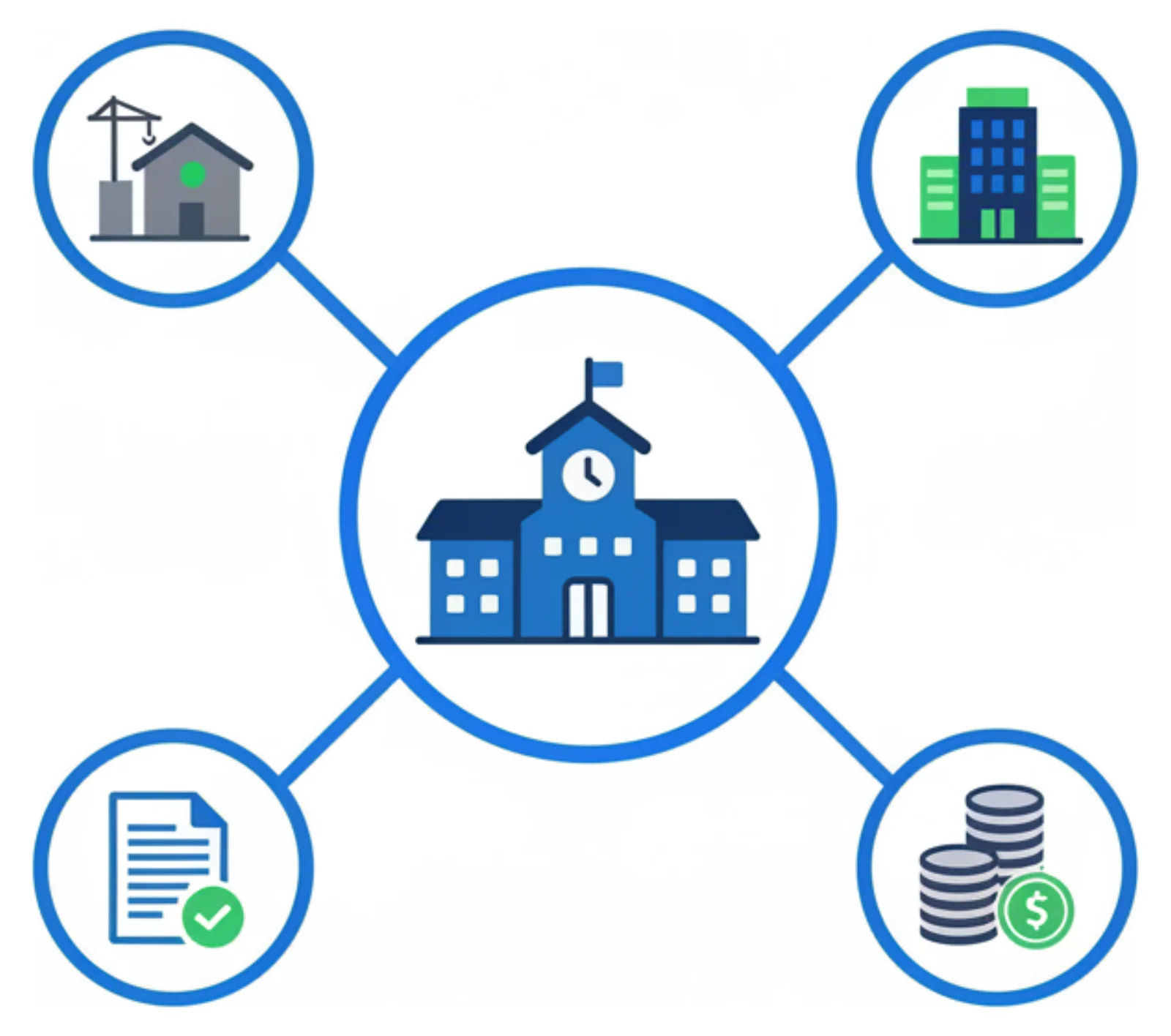
School developer fees are fees that qualifying California school districts may impose on certain construction projects to help fund school facility construction or reconstruction associated with development. California Education Code Section 17620 authorizes school district governing boards, subject to applicable statutory requirements, to levy a fee, charge, dedication, or other requirement against certain construction within district boundaries for school facility purposes.
These charges are commonly referred to as:
- School developer fees
- School development fees
- School impact fees
- Developer impact fees
- School facility fees
Whether a fee applies—and how much is due—can depend on the type of development, assessable square footage, the district's adopted fee schedule, applicable California law, and any exclusions or special circumstances.
Why Do School Districts Charge Developer Fees?
California's developer fee framework helps school districts address school facility needs associated with development. When a district adopts developer fees, it must satisfy applicable legal requirements supporting the relationship between development and the school facility costs the fees are intended to address. Developer fee studies and related district findings are commonly part of this process.
Developer fees differ from general building permit or inspection fees because they are specifically connected to school facility funding under California law.
Districts collecting developer fees must also administer the program: reviewing projects, applying current rates, processing payments, maintaining records, and documenting compliance.
Who Pays School Developer Fees?
School developer fees are generally paid by the person or entity responsible for a qualifying construction project.
Depending on the project, this could include:
Residential developers
Commercial developers
Industrial developers
Builders
Property owners
Businesses constructing or expanding facilities
Homeowners completing qualifying residential construction
Whether a fee is actually due depends on the specific project and the requirements of the applicable school district. For example, a new subdivision may be treated differently from an addition to an existing home. A warehouse or retail development may also use a different rate or calculation methodology than residential construction.
Before submitting a project, applicants can use a school development project registration checklist to prepare the information typically required during registration.
Which Projects Are Subject to School Developer Fees?
California Education Code Section 17620 identifies categories of construction to which a school district's developer fee may apply. These include new residential construction, new commercial and industrial construction, and certain other residential construction.
Actual fee applicability should always be confirmed with the applicable school district.
Residential Development
New residential construction may be subject to school developer fees, including projects such as:
New single-family homes
Multifamily residential projects
Residential subdivisions
New dwelling units
Certain residential additions or alterations
Certain accessory dwelling units, depending on their characteristics and applicable law
The 500-square-foot threshold
For construction involving an existing residence, California law includes an important 500-square-foot threshold. Education Code Section 17620 generally permits a fee on other residential construction only when the resulting increase in assessable space exceeds 500 square feet, subject to statutory exclusions. If that threshold is exceeded, the fee may apply to the total resulting increase in assessable space. Any decrease in assessable space in the same residential structure resulting from the construction is also considered.
Commercial Development
New commercial construction may also be subject to school development fees.
Examples include:
Office buildings
Retail developments
Restaurants
Hotels
Medical and professional offices
Service businesses
Other commercial facilities
The applicable rate or calculation depends on the district's adopted fee schedule and applicable requirements.
Industrial Development
Industrial projects may include:
Warehouses
Manufacturing facilities
Distribution centers
Processing facilities
Other industrial buildings
California's maximum Level I assessment groups commercial and industrial construction together, although an individual district's actual adopted rate may differ.
Other Development Projects
Some development projects require more individualized review.
Examples include:
Accessory dwelling units
Junior accessory dwelling units
Demolition and reconstruction
Government-owned projects
Religious facilities
Educational uses
Senior housing
Self-storage facilities
Community Facilities District projects
Projects involving previously paid developer fees
Because the applicable rate, exclusion, credit, or documentation requirement can vary, correct project classification is important. Applicants can review common project registration mistakes before submitting a project to help avoid preventable delays.
How Are School Developer Fees Calculated?
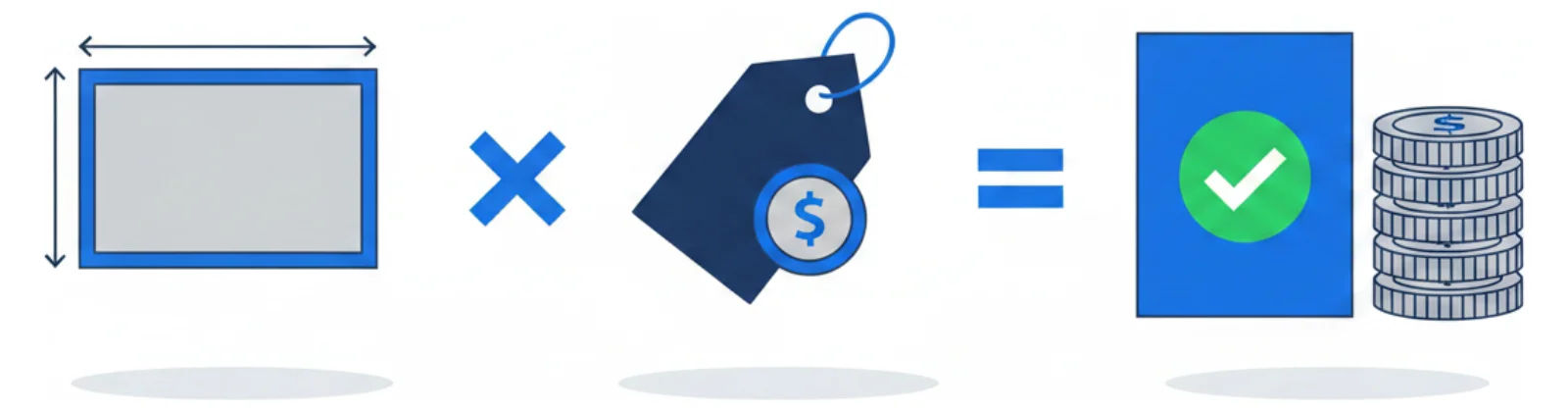
A basic school developer fee calculation often follows this formula:
The basic formula
Assessable square footage × applicable fee rate = estimated developer fee
The actual calculation depends on several factors.
Development Type
Residential construction and commercial or industrial construction generally use different Level I maximum rates. Individual districts may also adopt different treatment for particular project categories when legally supported. Correctly identifying the project's development type is therefore essential before applying a fee rate.
Project Size
Developer fees are typically based on assessable square footage, not the size of the parcel. For residential construction, Education Code Section 17620 includes specific rules governing when additions or other construction to an existing residence become subject to fees. For commercial or industrial projects, the statute also contains rules concerning chargeable covered and enclosed space, including treatment of structures already existing on a site.
Applicants should use the square footage recognized under the applicable legal and district requirements rather than assuming that every square foot shown in construction plans is automatically fee-assessable.
Applicable Fee Rate
After determining the project type and assessable area, the district applies its legally adopted rate. California's State Allocation Board establishes maximum Level I assessment amounts. A district does not automatically charge the statewide maximum simply because the maximum exists; the district must adopt and justify its applicable fee in accordance with California law.
As of January 28, 2026, the State Allocation Board established maximum Level I assessments of:
$5.38 per square foot
Residential development
$0.87 per square foot
Commercial and industrial development
Note: These are statewide maximum Level I assessment amounts, not universal rates charged by every California school district. Applicants should always consult the applicable district's current fee schedule. For current and historical rate information, see California School Developer Fee Rate Changes: 2026 Update and What to Expect in 2028.
Current Inflation Adjustments
California's maximum Level I developer fee amounts are adjusted periodically based on changes in the construction cost index used by the State Allocation Board. For 2026, the State Allocation Board approved a 4.06% adjustment, increasing the maximum residential Level I assessment from $5.17 to $5.38 per square foot and the commercial/industrial assessment from $0.84 to $0.87 per square foot. Because these maximums can change, project applicants and district staff should avoid relying on rates from earlier projects or older documents. Please see Developer Fee Inflation Adjustment Explained for more information on developer fee rate adjustments.
Exemptions and Special Circumstances
Some projects may qualify for an exclusion, credit, different calculation, or other special treatment under applicable law or district requirements.
Common examples are:
- Certain residential additions
- Certain ADUs and JADUs
- Demolition and replacement projects
- Previously assessed development
- Certain statutory exclusions
- Projects subject to specialized district requirements
Eligibility for an exclusion, credit, exemption, or other special treatment depends on the project, applicable law, and district requirements.
School Developer Fee Calculation Example
| Factor | Example |
|---|---|
| Development Type | Residential |
| Project Size | 10,000 sq. ft. |
| Applicable Fee Rate | $5.38 per sq. ft.* |
| Estimated Developer Fee | $53,800* |
*Illustrative example using the California maximum Level I residential assessment effective January 28, 2026. The actual fee may differ based on the school district's adopted rate, the project's legally assessable square footage, and any applicable exemptions or special circumstances.
For this hypothetical project:
10,000 sq. ft. × $5.38 = $53,800
Note: This example should be used only to demonstrate the calculation method. It should not be treated as a fee quote for an actual development project.
How Much Are School Developer Fees?
There is no single school developer fee amount that applies throughout California.
The final amount can depend on:
School district
Development type
Assessable square footage
District-adopted rate
Applicable fee level
Statutory exclusions or credits
Project-specific circumstances
As of January 28, 2026, California's maximum Level I assessments are $5.38 per square foot for residential development and $0.87 per square foot for commercial and industrial development. Individual district rates may differ. Qualifying districts may also impose alternative Level II or Level III fees when applicable statutory requirements are satisfied. For a specific project, applicants should obtain the current official fee schedule from the school district where developer fees are to be paid.
"It is not accurate to say that every residential school developer fee is always due at building permit issuance — or that every residential fee is always deferred until occupancy."
Payment Timing Under Government Code Section 66007
California Developer Fee Law
When Are School Developer Fees Due?
The timing of school developer fee payments depends on the project and applicable California law, including Government Code Section 66007. Special rules apply to a statutory category known as a designated residential development project (DRDP). Under the version of Government Code Section 66007 in effect in 2026, a DRDP includes residential projects that meet specified statutory criteria, including:
Designated residential development project (DRDP) criteria
- Projects dedicating 100% of units, excluding manager units, to qualifying lower-income households
- Certain low-barrier navigation centers
- Certain projects approved under specified streamlined housing laws
- Certain projects meeting statutory affordable housing criteria
- Projects entitled to specified density bonuses
- Residential projects containing 10 or fewer units
For qualifying DRDPs, Government Code Section 66007 generally provides that covered fees may not be required until the date the first certificate of occupancy or first temporary certificate of occupancy is issued, whichever occurs first, subject to statutory exceptions. The statute also provides circumstances under which earlier collection may be permitted. For school facilities, those circumstances can include specified findings and requirements involving a school facilities master plan, an established account, and appropriated funds.
Accordingly, it is not accurate to say that every residential school developer fee is always due at building permit issuance—or that every residential fee is always deferred until occupancy. Payment timing should be determined for the specific project under current law and the applicable district's procedures.
For district staff
School districts should consult their legal counsel regarding the application of Government Code Section 66007 to their own fee collection practices.
What Is the School Developer Fee Process?
Procedures vary by district, but most follow the same six steps from registration through compliance documentation.

Project Registration
Project information is submitted
Project Review
Applicable requirements are verified
Fee Calculation
Developer fees are calculated
Payment
Applicable fees are paid at the legally required time
Documentation
Project, calculation, and payment records are maintained
Compliance
Required compliance documentation is issued
1. Project Registration
The applicant provides information about the development project.
This may include:
- Project address
- Property owner
- Applicant information
- Permit information
- Development type
- Project description
- Square footage
Applicants can use a development project information template to organize this information.
2. Project Review
District staff review the project. Review may include:
- Verifying that the property is within district boundaries
- Confirming the development classification
- Reviewing assessable square footage
- Identifying applicable rates
- Evaluating claimed exclusions or special circumstances
- Reviewing supporting documentation
3. Fee Calculation
The district calculates the applicable fee using assessable space and its current adopted fee schedule, accounting for legally applicable exclusions, credits, or project-specific requirements.
4. Payment
The applicant pays the amount due according to the applicable payment timing rules and district-approved payment methods.
5. Documentation
The district maintains records supporting the transaction.
Those records can include:
- Project information
- Square-footage calculations
- Applicable rate
- Fee calculation
- Payment information
- Supporting documents
- Exemption or special-case documentation
- Compliance records
6. Compliance Documentation
After applicable requirements are satisfied, the district may issue a Certificate of Compliance or other applicable documentation confirming that the project's school developer fee requirements have been addressed. Local permitting agencies may require this documentation as part of their development approval process.
What Documents Are Needed for School Developer Fees?
Requirements vary by district, but applicants commonly need:
- Development address
- Property owner information
- Applicant contact information
- Building permit or permit application
- City or county documentation
- Project description
- Residential, commercial, or industrial classification
- Project square footage
- Plans or documents supporting assessable square footage
- Documentation supporting a claimed exclusion or special circumstance
- Records of previous construction or fee payments when relevant
Submitting complete and accurate information can reduce delays during project review. For a more detailed preparation guide, see Documents Needed Before Registering a Development Project.
School Developer Fee Exemptions and Special Circumstances
California developer fee law includes several situations that require additional analysis.
Residential Additions and the 500-Square-Foot Rule
For construction involving an existing residence, Education Code Section 17620 generally permits a developer fee on other residential construction only when the resulting increase in assessable space exceeds 500 square feet, subject to statutory exclusions.
The relevant figure is the resulting increase in assessable space, not simply the stated size of an addition. If construction decreases assessable space elsewhere in the same residential structure, that decrease is considered when determining the resulting increase. If the threshold is exceeded, the fee may apply to the total resulting increase in assessable space.
Accessory Dwelling Units and Junior Accessory Dwelling Units
ADUs and JADUs require careful review because California law governing these projects continues to evolve. Effective January 1, 2026, California law provides that, for purposes of Education Code Section 17620, an ADU or JADU containing less than 500 square feet of interior livable space is considered other residential construction that does not increase assessable space by 500 square feet.
School developer fees therefore should not be described as either universally applicable or universally exempt for ADUs. The size and characteristics of the unit, current law, and applicable district requirements should be reviewed.
Demolition, Reconstruction, and Existing Structures
Projects involving demolition, replacement construction, or an existing structure may require additional review. Applicants should provide accurate documentation describing both the existing and proposed construction.
Other Special Circumstances
Additional circumstances can include:
Prior developer fee payments
Project revisions
Community Facilities Districts
Specialized housing
Government projects
Statutory exclusions
Changes in project use
Multiple construction phases
Applicants should obtain a district determination rather than relying on past projects or fee payments.
What Happens If Developer Fees Are Not Paid?
If legally required school developer fees are not paid when due, the project may not have completed the applicable school district compliance process.
Depending on the project and applicable law, nonpayment can affect:
Nonpayment can affect
- Issuance of compliance documentation
- Building permit procedures
- Final inspection
- Certificate of occupancy procedures
- Coordination with the city or county
- Project closeout
California Government Code Section 66007 also contains specific enforcement provisions for certain deferred residential development fees, including contractual and lien-related mechanisms in applicable circumstances. The exact consequences of nonpayment depend on the project, payment timing, district procedures, and current law. Clear project and payment records help both applicants and school districts establish whether developer fee requirements have been satisfied.
How School Districts Manage Developer Fees
School developer fee administration can require district staff to carry every project through intake, review, calculation, collection, and auditable reporting.
What district staff manage
Register and review projects
Verify district jurisdiction
Determine development type and assessable space
Apply current fee schedules
Evaluate exclusions or special circumstances
Calculate and reconcile fees
Track deferred or outstanding payments
Maintain supporting documents
Issue compliance documentation
Update fee rates
Maintain auditable records and reports
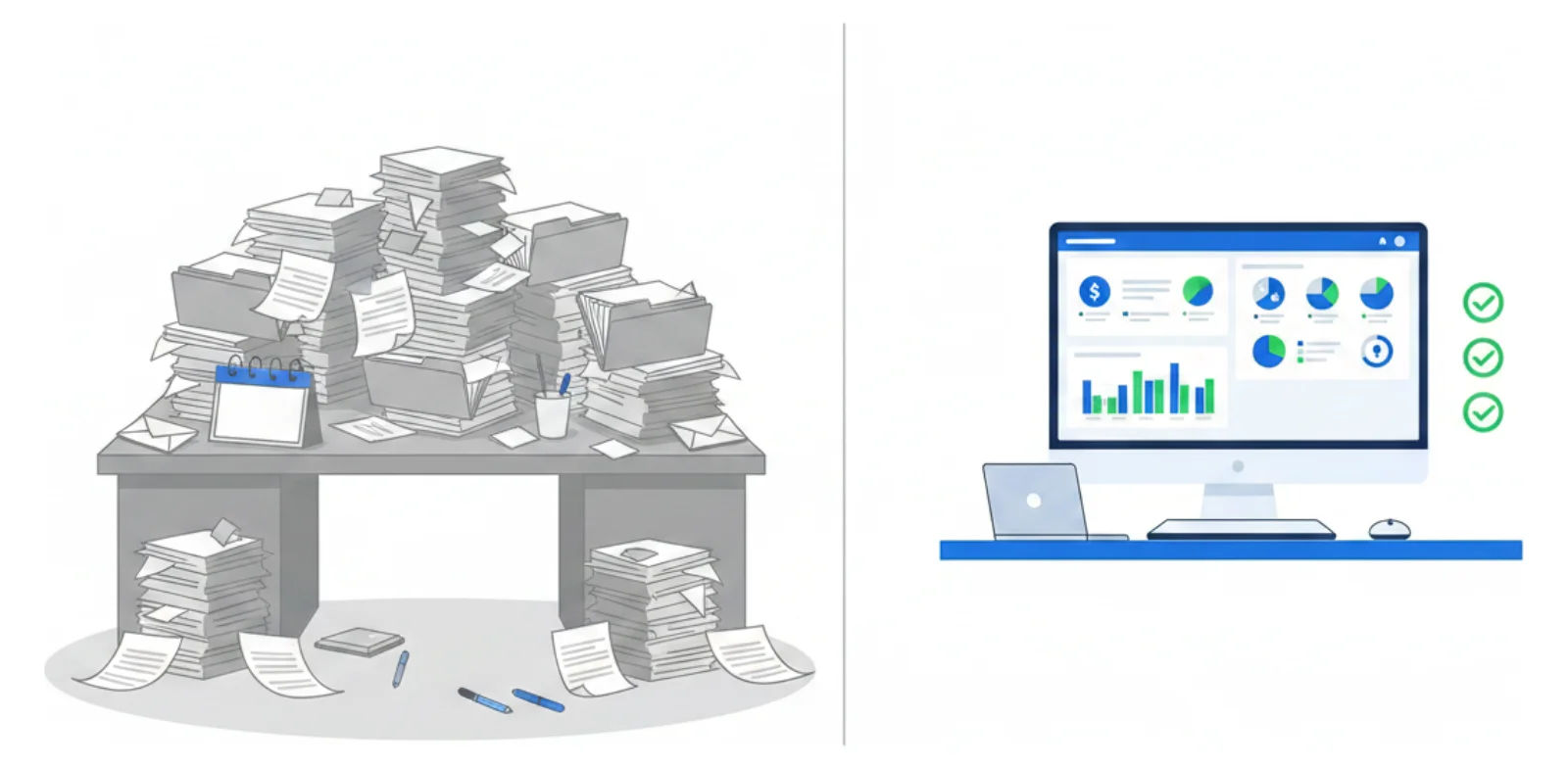
When these functions are handled through a combination of paper forms, spreadsheets, email, checks, and separate file-storage systems, the process can become difficult to track. Changes in California law can add another layer of complexity, particularly when different projects have different payment timelines.
How Developer Fee Management Software Streamlines the Process
Developer fee management software can bring project intake, calculation, payment, documentation, and compliance into a centralized workflow.
Potential benefits include:
Online project registration
Applicants can submit project information without relying on paper forms or office visits.
Consistent project review
District administrators can follow a standardized workflow when reviewing projects.
Configurable calculations
Current fee schedules and project specifications can be incorporated into calculation tools.
Electronic payments
Applicants can pay applicable fees online when due.
Centralized documentation
Required project records can be issued and stored digitally.
Payment tracking
Districts can more easily identify projects with paid, deferred, or outstanding obligations.
Reporting and visibility
Administrators can use centralized data to monitor activity, payments, and project status.
For districts processing numerous projects, these capabilities can reduce manual data entry and fragmented recordkeeping.
How Facilitron DevFees™ Helps School Districts Manage Developer Fees
Facilitron DevFees™ centralizes developer fee administration for California school districts.
What the platform supports
Online development project registration
Digital project submission and review
Built-in fee calculation tools
Configurable fee schedules
Online fee payments
Project document management
Project status and payment tracking
Issuance of compliance documents
Reporting
See how the platform handles project intake, fee calculation, payments, and compliance documentation.
For developers and project applicants working with participating districts, Facilitron DevFees™ provides an online process for submitting project information and paying applicable developer fees. For district administrators, it creates a centralized record of project details, including fee calculations, documents, and payments. Facilitron DevFees™ also provides functionality for generating a Certificate of Compliance after applicable project requirements and fee verification have been completed.
Simplify Developer Fee Management
Facilitron DevFees™ centralizes project registration, fee calculation, online payments, documentation, and compliance reporting for California school districts.
Simplify School Developer Fee Management With Facilitron DevFees
School developer fees are an important part of California's school facility funding framework, but administering them involves more than calculating applicable developer fee rates. Districts must account for project details and meet compliance requirements under evolving California law. Developers and project applicants face many of the same complexities from the other side of the process.
A centralized digital workflow can make that process easier to manage.
Facilitron DevFees™ helps California school districts manage development projects, calculate school impact fees, accept secure online payments, maintain project records, track fee status, and issue compliance documentation through one system.
Ready to streamline your district's developer fee process? Explore Facilitron DevFees™.
If you are a developer, builder, homeowner, or project applicant working with a participating district, visit the Facilitron Developer Fees™ Portal to register a project or manage an existing one.