
A Complete Guide to
School Facility Management Best Practices
A governance-driven guide to school facility management for K-12 and higher education leaders seeking to connect daily operations with district mission, policy, and long-term planning.

Introduction
The New Era of School Facility Management
School facility management has entered an era defined by strategy, accountability, and governance — where every building, classroom, and field is a potential-filled public asset.
The role of school facility management has entered a new era — one defined by strategy, accountability, and governance. Across K-12 districts and colleges, leaders are realizing that every building, classroom, and field is a potential-filled public asset that reflects the district's priorities.
This shift toward strategic facility management reframes how districts operate. Governance — the alignment of policy, process, and performance — now sits at the center of education facilities management. Instead of reacting to problems, forward-thinking districts establish standards, track data, and manage facilities through transparent, policy-based systems. When supported by tools like facility maintenance management platforms and facility scheduling and reservation software, governance becomes actionable: maintenance is preventive, scheduling is fair, and community use aligns seamlessly with board policy.
Key Takeaway
However, challenges facing school districts are more pronounced than ever. Aging buildings, budget limitations, and rising safety concerns have pushed facility leaders to find better solutions. Strategic governance offers that path forward — clarifying roles, enforcing standards, and giving districts the insight to anticipate school facilities problems and solutions. It also answers the question of how to maintain school facilities efficiently, by pairing clear accountability with facility management systems that track every asset, inspection, and event.
What is School Facility Management?
School facility management is the strategic coordination of the people, processes, and systems that keep campuses safe, functional, and ready for learning every day. It goes beyond basic building upkeep. Effective school facility management includes maintaining physical infrastructure, managing assets and equipment, coordinating custodial services, supporting safety and compliance, and ensuring spaces are available and prepared for instructional and community needs. When districts approach facility management as a governance-driven discipline, facilities become an organized and measurable part of the educational mission — not a constant source of unexpected issues.
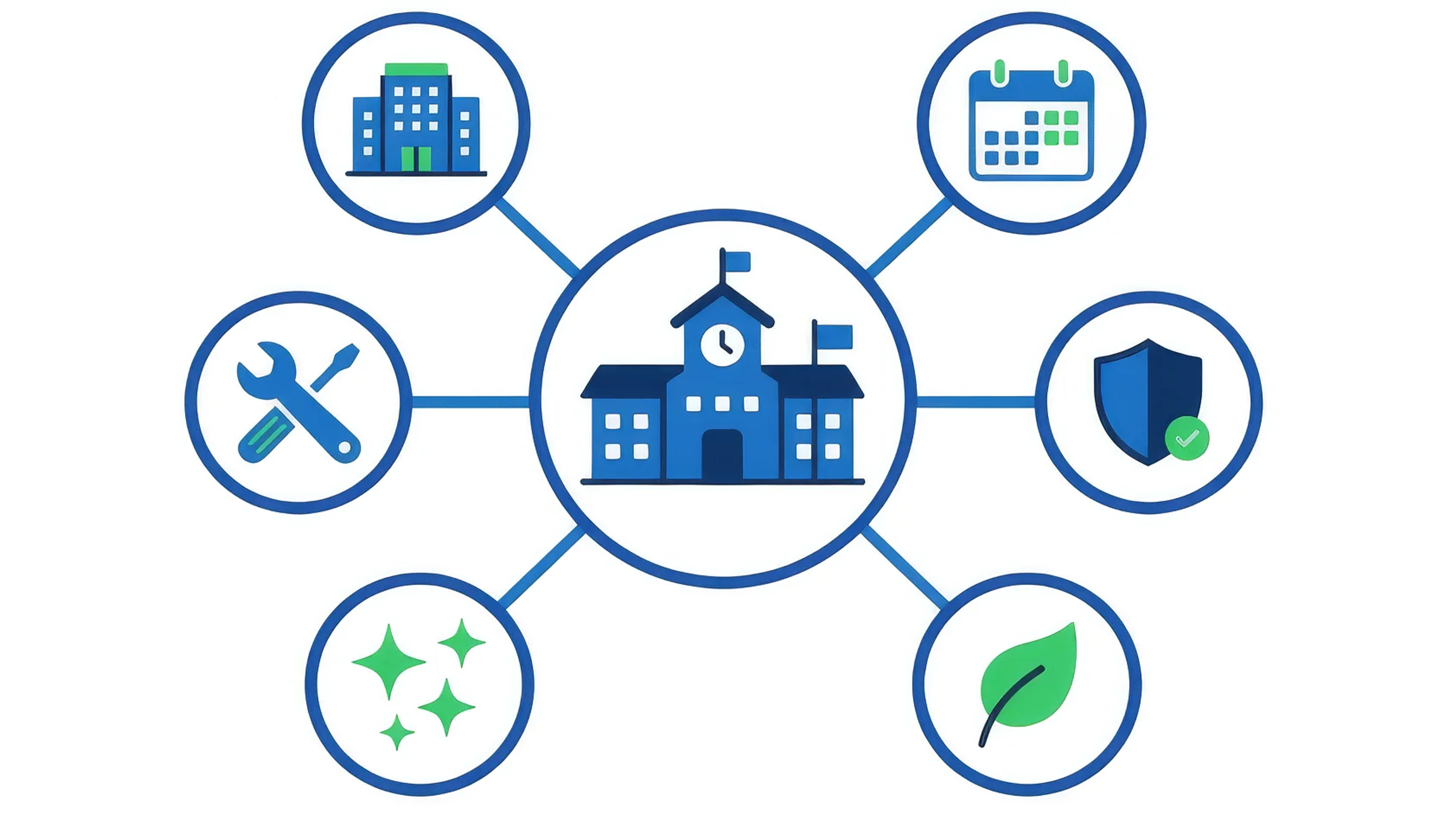
At its core, education facilities management is about stewardship. School districts are responsible for managing public assets that serve students, staff, and often the community as well. These facilities include classrooms, administrative buildings, multipurpose rooms, parking lots, athletic fields, cafeterias, playgrounds, and more. Each space requires consistent care, oversight, and long-term planning. Without clear standards, districts often fall into reactive cycles where minor repairs become costly problems and resources are stretched thin.
Maintenance & Operations
Work orders, repairs, preventive maintenance, and capital planning across every campus.
Scheduling & Community Use
Facility access for school events and community use, aligned with board policy.
Compliance & Inspections
Monitoring compliance through inspections, documentation, budgets, and sustainability goals.
Software has become essential to this new era of school facility management. Facility maintenance management platforms support preventive maintenance, track asset lifecycles, and create clear work order systems that improve accountability. Facility scheduling and reservation software helps districts manage facilities equitably, avoid conflicts, and ensure community use aligns with policy. Facility inspection tools and building automation systems bring visibility into safety, compliance, and energy performance. Together, these tools allow districts to manage K-12 and higher education facilities with transparency, coordination, and long-term planning.
The most effective facility programs treat school facilities as a strategic investment. When districts align governance, policy, and software systems, they can improve school operations efficiency, reduce disruptions, and maintain safe learning environments that support students for years to come.
The Governance Era of School Facility Management
School district leaders throughout the country are realizing that effective management of educational facilities depends as much on structure and policy as it does on maintenance and scheduling. Governance introduces consistency, transparency, and accountability into every facility-related decision. Instead of allowing each campus to operate independently, districts establish centralized standards that align facility operations with educational goals.
In a governance framework, policies and facility management software work hand in hand. Centrally-approved procedures determine how schools handle maintenance, assets, and community use, while platforms like facility scheduling software and a computerized maintenance management system (CMMS) operationalize those rules. Each maintenance task becomes a documented action — ensuring compliance across every site.
Using a governance-based approach to school facility management, every maintenance task becomes a trackable action. Preventive maintenance schedules are standardized across campuses. Community use requests follow the same approval process district-wide. Leaders gain real-time visibility into performance, costs, and compliance across all educational facilities.
This Level of Oversight Enables Districts To:
Balance resources across schools
Plan capital investments with confidence
Demonstrate accountability to boards and communities
Reduce risk through consistent compliance
Ultimately, facility management for schools is about governing grounds responsibly and with forward-thinking. Governance and facility management software together create a sustainable model of education facilities management where every school facility reflects the district's mission.
Common School Facilities Problems — and Governance-Based Solutions
While every district is unique, there are some challenges that every district faces: aging buildings, limited staff, and constrained budgets. Facility governance offers the framework schools need to manage facilities proactively, replacing reactive fixes with policy-driven solutions.
Aging Infrastructure & Maintenance Delays
Deferred maintenance is one of the most common challenges in public institutions such as K-12 facilities. Without clear standards and tracking, small issues escalate into costly repairs that disrupt learning.
A governance-driven approach establishes preventive maintenance policies that define inspection cycles, response times, and accountability. Facility maintenance management software supports this structure by enabling districts to:
Schedule recurring maintenance tasks
Track asset lifecycles and warranties
Document repairs and labor costs
Reduce downtime and emergency work orders
This combination of policy and facility maintenance management solutions helps districts extend the life of critical assets while minimizing unexpected expenses.
Budget and Staffing Constraints
Limited budgets and staffing shortages force districts to make difficult trade-offs. Governance helps leaders prioritize resources based on data rather than urgency alone.
Standardized approval workflows and centralized reporting allow administrators to see where funds are being spent and where efficiencies can be gained. Dashboards and analytics highlight trends across campuses, enabling strategic planning that maximizes impact while supporting school operations efficiency.
Energy Efficiency and Sustainability
Energy costs represent a significant portion of district operating budgets. Without oversight, inefficiencies can go unnoticed for years.
Governance ensures that energy management is measurable and accountable. By integrating building automation systems, districts can monitor usage, identify inefficiencies, and document progress toward sustainability goals. This data-driven approach supports compliance with environmental standards while reinforcing fiscal responsibility.

Security and Compliance
Safety expectations have never been higher for educational facilities. Facility governance formalizes inspection routines, visitor management, and emergency preparedness.
Using facility inspection tools and centralized facility management software, districts can maintain verifiable records of inspections, corrective actions, and compliance activities. This creates a continuous trail of accountability that protects students, staff, and the district as a whole.
The Advantage of Facility Governance
With governance as the backbone, school facility management becomes strategic. Policies define expectations clearly, and management software enforces them. Together, they enable districts to maintain safe and well-functioning schools that serve students and communities for the long term.
"When school facility management is grounded in governance, schools stop going through the motions of outdated processes. Policies become the foundation for accountability, and data turns into proof of proactivity."
School Facility Management Insight
Industry Perspective
How Can We Maintain School Facilities Strategically?
Understanding how to maintain school facilities today means managing them through structure and purpose. Modern facility management for schools combines clear policy, staff collaboration, and software tools that turn maintenance into a well-defined and proactive process.
Facility governance provides that structure. District policies define maintenance schedules and protocols — ensuring every site meets the same standards. Facility maintenance management and preventive maintenance software help teams schedule work, document progress, and analyze performance.
Regular inspections keep campuses safe and compliant. Using facility inspection software, districts can standardize inspections, store reports, and track issues before they escalate.
Facility management software ties it all together. Dashboards give leaders visibility into costs and trends across educational facilities, while automated alerts keep preventive tasks on track even with limited staff. The result is a data-driven system where every task aligns with policy and safety priorities.

Strategic facility management also depends on coordination between maintenance, custodial, technology, athletics, and school site administration. When roles and responsibilities are clearly defined, facilities teams are empowered to work efficiently and avoid delays caused by miscommunication. Governance supports this coordination by creating clear handoffs — for example, how work requests are submitted, how approvals happen, and how completion is verified. With software in place, these processes become transparent, auditable, and aligned with district-wide expectations.
The question of how to maintain school facilities effectively comes down to consistency. With a governance model, districts don't rely on individual habits or site-based workarounds. They build repeatable maintenance standards supported by data. Over time, this strengthens safety, reduces cost volatility, and ensures facilities remain ready to support student learning — without constant disruption.
The School Facilities Checklist for Accountability and Improvement
In governance-based facility management for schools, checklists turn policies into daily routines, helping staff uphold safety, compliance, and operational consistency across every campus.
Daily & Weekly
- Log and manage maintenance requests digitally in your CMMS
- Update custodial and work order completion records for district visibility
- Confirm facility schedules in scheduling platform align with policy for community and internal use
- Ensure all maintenance or safety tasks are signed off by site supervisors
Seasonal & Annual
- Schedule preventive maintenance using preventive maintenance software to reduce costly repairs
- Perform facility condition assessments; record results in the facility inspection tool
- Evaluate building automation systems data for energy management and sustainability improvements
- Plan capital improvements based on maintenance data and policy priorities
Safety & Compliance
- Use school facility management software to record visitor access and staff presence, maintaining a secure log of accountability
- Revisit emergency response plan and how to leverage facility management software to support it
- Submit inspection and safety data to district offices using a facility inspection tool
In governance-based school facility management, checklists are not just operational — they're strategic. They provide measurable proof that district facilities are being maintained consistently, safely, and in alignment with policy.
The Role of Software in Governance-Based Facility Management
A modern facility management system turns policy into action, ensuring every inspection, rental, and repair process is a catalyst for district objectives. By combining strategic governance and facility software, administrators are no longer simply managing educational facilities; they're leading their schools with shared values and deliberate goals.
School facility management software is a one-stop shop for simplified daily workflows and streamlined tracking. For maximum efficiency, it should cover:
Maintenance & Asset Management
Track costs, log repairs, and bring visibility for budgets and capital expenditures.
Facility Scheduling & Reservations
Create integrity and consistency in community use with automated processes and dynamic reporting.
Inspections & Compliance
Standardize inspections, store reports, and maintain continuous compliance tracking.
Building Automation Integration
Monitor energy usage, track facility use trends, and boost sustainability and budget goals.
Software also strengthens governance by building accountability into the workflow itself. Instead of relying on manual documentation or informal communication, districts create a clear system of record that tracks who requested a task, who approved it, who completed it, and when. This is especially valuable when leadership changes occur, budgets are audited, or compliance documentation is required.
A governance-based facility management approach supported by software ensures that districts aren't solving the same problems repeatedly. Instead, they develop processes that improve over time — reducing deferred maintenance, increasing visibility, and strengthening planning for capital needs.
Case Study: Anaheim Union
Learn how Anaheim Union revolutionized their facility rentals with a revenue-sharing approach that benefits schools, staff, and the community alike.
When governance frameworks are embedded in school facility technology, education facilities management becomes proactive, measurable, and mission-aligned — building systems that sustain both operations and learning outcomes.
Strategic Governance Starts with the Right Tools
Discover how your district can focus oversight and streamline facility operations with Facilitron's comprehensive facility management suite.
Governing for the Future of Education Facilities
In the modern era, the most effective districts are asking how to lead through their facilities. Governance provides that answer by establishing structure in decision-making and consistency in daily operations. When school facility management is grounded in governance, districts begin to anticipate and mitigate challenges before they arise, allowing facilities management to be a catalyst for their mission to provide spaces that foster learning.
Governance also strengthens alignment across a district by making expectations clear and consistent for every campus. Instead of relying on informal practices or site-by-site decision-making, district leaders can standardize how maintenance is prioritized, how resources are allocated, and how community use of schools is managed. This model supports school operations efficiency by creating consistency and ensuring facilities are responsibly cared for over time.
Facility management software has become the essential partner in this transformation. School facility software simplifies management and ensures that community use aligns with policy. These software tools make governance tangible and present in every step. Facility governance, supported by comprehensive software, turns school operations into a system that empowers administrators to plan ahead, optimize resources, and demonstrate measurable impact.
When paired with strong policy, these tools help districts manage educational facilities as a coordinated system rather than a collection of independent sites. Leaders gain visibility into costs, maintenance trends, and facility use patterns — allowing them to make informed decisions that reduce disruptions and improve long-term outcomes.
Lead with Strategy, Govern with Purpose
By leading with strategy and governing with purpose, districts create learning environments that serve as catalysts for school, community, and student success.